Saturday, January 18, 2020

Honor Educators

Cambridge dictionary defines honor, when used as a verb, in the following way:

  • to show great respect for someone, especially in public
  • to give someone a public reward to show appreciation for unusual achievement
We honor people in a number of different ways.  On a grand scale, we set aside holidays, we build monuments, and we name buildings to honor those who have had a major impact on society or who have made significant contributions to our world.  We also honor people with ceremonies, assemblies or dinner events, where we present them with with certificates, trophies, or gifts.   Educators throughout history have been honored in many ways, sometimes in a public manner, but more often through private means such as notes from students or families and passing comments from students or peers. 

All educators deserve to be honored, and I am always so pleased when I see people being intentional about honoring them in a public way.  In fact, our office has recently decided to begin hosting a yearly Educator Gala to honor and celebrate the educators in our region.  As we plan, however, I want to ensure that we are deliberate in honoring ALL of the most deserving members of the educational community.  Unfortunately, I have seen too many instances where the loudest and flashiest educators are recognized while the ones who work more quietly and thoughtfully in the background are overlooked.  Often the latter group educators is made up of the ones who do not want the extra attention or the accolades, however it is just as important for them to be honored publicly.

Recognition intended to honor people does not have to be costly or time intensive, but it must be genuine, authentic, and relevant.  West Aurora School District 129 has established an annual recognition, called The Power of You, which is a ceremony embedded in their January School Improvement day. I was honored to be invited to witness this  year's amazing event and it did not disapooint.  I was completely blown away by the professional approach they took in honoring and celebrating educators in an incredibly genuine and authentic way.  It is extremely relevant because it is focused on their vision and it honors members of their community past and present.  It is held on a school improvement day, allowing all 1200 members of their staff to be present.  Furthermore, it is held at West Aurora High School and is supported by their own tech and operations staff, making it fiscally manageable.  

The morning started off with a 3 minute video of short clips of students, staff, and families engaged in a variety of activities throughout the school district and community.   The lights dimmed and the large audience was welcomed by assistant superintendent, Dr. Brent Raby, who reiterated the theme for the year, which is Embrace the Journey.   The next 90 minutes was devoted to honoring and celebrating members past and present of the West Aurora community.  Dr. Michael Smith, assistant superintendent, called the teachers who became National Board Certified Teachers within the last year to the stage and presented them with certificates so they could be celebrated by all of their peers.  Next, three teachers were presented with scholarships providing them the financial support to attend a national conference of their choice where they will extend their learning and then return to share their learning with other educators in the West Aurora district.  Dr. Jeff Craig, superintendent, presented customized Challenge Coins (pictured below) to five West Aurora leaders who have demonstrated commitment, courage, excellence and integrity as they have dedicated their lives to their community and schools.  
I especially loved the next part of the ceremony where educators were presented with the Golden Apple award, which Dr. Craig described as the highest honor awarded to educators in West Aurora.  Eight educators, including an administrative assistant, a paraprofessional, an operations employee, and a variety of teachers, were named Golden Apple Award recipients.  They were invited to the stage where they were met by family members and presented with a gift and flowers.  While they were on the stage, a video of their peers and students talking about whey they deserve to be honored was shared.  The response from the crowd and the heartfelt testimonials brought me to tears despite the fact that I did not know a single one of the educators being honored.  The recognition part of the morning was closed out with an on stage recognition of all staff members who have served 25 years.  

My emotions continued to be tested by the final part of this amazing experience, which was the 2020 West Talks (click here to see videos of other West Talks from previous years).  In line with the theme, Embrace the Journey, two current teachers and one former student shared their journeys, which included struggle, but also a resilience which was supported and inspired by caring people.  I cannot really do them justice without making this blog way too long, so I encourage you to keep checking the link above too that when they are posted, you can watch them for yourself.  

Well done, D129.  You made it a priority to take 90 minutes out of your school improvement day to build community, appreciate your staff, and honor and celebrate what matters most.  

Saturday, December 28, 2019

Never. Give. In.


“Never give in--never, never, never, never, in nothing great or small, large or petty, never give in except to convictions of honor and good sense. Never yield to force; never yield to the apparently overwhelming might of the enemy.”

― Winston Churchill


These wise words were uttered by Winston Churchill during a speech he delivered to students at Harrow School, a boarding school he attended 53 years prior. I first heard these words when I was quite young and I have used them as motivation more than once. I recently had to dig deep to find the strength to keep from yielding to negative forces as I found myself entirely too close to giving up on everything I have dreamt of doing in education.


Churchill shared this sentiment in 1941 while England was reeling from the misfortunes of World War II. While the challenges I have faced pale in comparison, they are, nonetheless, significant in my world. I have spent my entire educational career chasing the belief that we can do better in public education, that we can have a system where all children are included and challenged. I have dreamt of schools where educators receive the respect and accolades they rightly deserve and where all children are excited about learning and want to be challenged in all that they do. Despite many obstacles and many non-believers, I have continued to dream and cultivate my vision. As one of my good friends likes to say, I have been a Pollyanna believing only the best in all people and all situations.


My resolve was tested by a series of events that occurred in the span of just three days. In this short period of time, I witnessed a bureaucracy that prioritized pencil-pushing to the point of jeopardizing the amazing work that is having a demonstrated positive impact on student learning in schools. I watched an initiative to which I devoted more than seven years of my life crumble and fall apart in a very public way. The final straw was the realization that non-educators are making devastating decisions that are impacting the future of a district desperately in need of a savior.


My inner Pollyanna could not provide me with enough grace to extend to all of these situations and people at once. I stood with my toes hanging over the cliff, garnering the strength to set my sights on a new passion and vision. Thankfully, I have amazing colleagues, friends and family who reached out and yanked me away from the cliff's edge while offering encouraging words. One of them reminded me that we have "the greatest jobs in the world" and that "every single day we get to wake up and choose to either make a difference in the lives of others or not." This same person countered my discouragement by telling me that "the only way you know for certain it won't happen in your lifetime is to not chase your dream through maximum effort" and to "Embrace the pain over mediocrity, you will have company." I also had good friends who were quick to remind me of the successes we are currently experiencing in schools right here in Illinois, then reassured me that I am not and will not be alone in this journey. My father, in his infinite wisdom, reminded me that the daughter he knows is too gritty and determined to walk away. He shared a Robert Kennedy quote that came to mind as he listened to me share my woes. What I didn't know at that moment was that he would proceed go home and order this picture for me as a reminder to keep forging ahead:


As we enter a new calendar year, my resolution is to fight the good fight, and my hope for fellow dreamers is that you will have the strength and support from friends and family so that you never, never, never, never give in. We have the best jobs in the world and our children and our future are worth it. Surround yourself with good people and keep the stars shining in your eyes!

Thursday, December 5, 2019

Challenge to change

A year ago, I was beginning to lose hope in my starry-eyed dream to see schools engaged in the kind of school improvement that produces positive and significant impact on learning for ALL students.  Throughout my career I had seen too  many false-starts, implementation failures, surface level or unsustainable changes, unreasonable expectations for change, and indifference to the need for change.  I started to wonder whether I would see the solution during my career.  Fortunately, I was introduced to the Challenging Learning Process through Challenging Learning.  I wrote about my first experience visiting a school that had engaged in the process in September when I described the re-imagining of learning that took place at a school in Denmark.  I realize that some people may have read my refection and questioned whether something like that could happen in US schools.  Well, it is happening in West Aurora, and it is quite amazing!

The Challenging Learning Process (CLP) supports a culture of organizational growth, leading to shared ownership, distributed leadership and a culture of collaborative learning and collective efficacy.  The process is made up of continuous action learning cycles that are shaped through a collaboration between the school and Challenging Learning (CL).  The process is fully supported by CL, but is driven by the school and is focused on specific aims that are tailored to the needs and vision of the school.  It includes evaluation of impact, ongoing monitoring and a comprehensive structure which ensures sustainability.  In West Aurora, the following aims were crafted based on a desire of assistant superintendent Brent Raby for "teachers to be enthused in their craft" and the desire of students and teachers to rediscover "the joy of learning":
1- A culture of challenge for all learners
2- Students who are able to make lasting meaning of their learning
3- Students are independent and resilient learners.

The work in West Aurora began in the spring of 2019 when administrators and teachers on the leadership team began collaborating with consultants from CL to plan and design the project.  The first 4 schools rolled out in earnest in August with their first training day.  I have made two visits to one of the schools in the first wave, Hall Elementary School.  During the first visit in September, I was able to observe model lessons being taught by CL consultant Lisa Cook.  Lisa taught a class from Hall while the teacher teams observed and discussed what they were seeing.  The dialogue among the teachers was incredibly rich as they enthusiastically shared ways they could make changes to their instruction.

Hall Elementary

Today was my second visit to Hall Elementary and I was blown away!  I visited classes at all levels and saw a variety of subjects, but in every class I could clearly see that they were focused on shifting the talk from teachers to students, to incorporate deeper thinking and challenge, and to develop a common, shared language around learning.  The students in the classrooms were engaged, supportive of one another, and motivated to participate and learn.

I was able to sit down with the principal, Zak Fitzenreider, and the Assistant Superintendent of Operations, Angie Smith to hear about the journey at Hall.  Mr. Fitzenreider shared with me that prior to the CLP, they were seeing 4-5 behavior referrals a day in the office, but now they only see about 1 a day, if that.  They were also engaging in multiple CPI supports per week for students who were physically out of control, and they have not had one incident requiring CPI support this year.

According to Mr. Fitzenreider, the environment is now set up such that it feels inappropriate to the students to misbehave.  Mrs. Smith added that students were misbehaving because they were not engaged and did not care if they had to leave the classroom to go to the office, whereas now they do not want to leave the classroom and risk missing anything.  Prior to the CLP, many staff members believed that they needed to address the social emotional concerns first before attempting to tackle instruction and academics.  What they now realize is that by enriching their instruction, they have significantly reduced the number of actual concerns in that area.  As they shifted their focus to the delivery of universal challenging instruction instead of the behaviors, they were no longer engaged in power struggles.

An instrumental part of the CLP, which helped the staff at Hall to truly integrate Social Emotional Learning and academic learning, is the ASK (Attitudes, Skills, and Knowledge) model.  Simply focusing on attitudes and developing the attitudes that allow students to effectively build their skills and knowledge provided a connection between SEL and academics.

Another advantage of the CLP is purely academic.  Mr. Fitzenreider shared that they had already put significant work into developing excellent curriculum materials based on essential questions and supported by well developed resources, but that they were not seeing the impact of the curriculum.  He now realizes that they were missing the context for the "why".  The CLP has allowed them to embed a common language around learning and a shared understanding of the meaning of learning.  They are now seeing the impact of their curriculum work.

Mr. Fitzenreider indicated that this has been an easy sell to the staff and that he has had no resistance. In fact, the structure of the CLP, which allows the educators to work a their own pace as they focus on one aspect of the learning culture at a time, has led to teachers who are much happier and who are fulfilled by the success they are seeing in their classrooms and in the building as a whole.  Mrs. Smith  agreed, saying that for her it was an easy sell because it is a much better use of district dollars given the impact they are realizing.  The CLP is a school improvement process that encompasses all aspects of the learning culture and includes all stakeholders, eliminating the need for additional dollars to be spent on ancillary processes or programs.

Hall is not the only school in West Aurora experiencing success.  The school district saw the value and impact experienced by the original 4 schools and is now adding 5 more schools.  I was fortunate enough to observe portions of the baseline visits to 2 of the additional schools and I was pleased to see that some of the principles of Challenging Learning were already being cultivated, even before starting the process.

The CLP is unlike anything I have seen, and I truly believe it is what we need in order to make the long term changes necessary to create school cultures that challenge ALL students while preparing them for a future that is constantly changing.  We need to disrupt the "way we have always done things" and I believe this process does just that.

Wednesday, November 13, 2019

Highly Engaging High Schools

I recently had the opportunity to visit a few schools in the Seattle area that are doing great things to engage high school students in learning and in preparation for their future.  There were so many things to love about what we saw:  high levels of student engagement, community involvement, district commitment to innovative ideas, flexibility in rules and procedures for the sake of children, collaboration, and a willingness to change to keep getting better.

The first two schools we visited were a part of the Highline School District (www.highlineschools.org/@HighlineSchools).  Highline is a diverse, K-12 district outside of Seattle with approximately 20,000 students and 33 schools.  The first school we visited was Raisbeck Aviation, a choice high school with an aviation and aerospace focus.  The school was formed in 2003 by the Highline district to serve students from the whole Puget Sound Region.  The students are selected on a lottery basis and represent 25 districts, although 50% of them come from the Highline school district.  The learning environment is entirely project based and has a STEM focus.

After entering the school, which sits right next to the Museum of Flight and a hangar with Boeing aircraft just feet from the building, we were escorted by two AMAZING students who were very patient with our constant barrage of questions.  The students walked us through the lab where they learn to create and operate robotic devices, then one of the students, a junior, proudly showed us the solar car that his team has been constructing in preparation for a national competition.
We visited a freshmen class, Physics of Flight, that was completing their first project which challenged them to design an aircraft that would withstand heat and impact testing.  In addition to coming up with the concept, creating the design, building the aircraft, and testing their aircraft, the students also presented their designs to a panel of engineers.  They openly discussed what they learned from their failures as well as their successes.  When students are expected to get up in front of engineers at the age of 14 to discuss complex work and make themselves vulnerable, and then they continue to do that for four years of high school, it is exciting to think about the composure and confidence they will have when they enter college and then the work force! In addition to the amazing relevant curriculum and projects, the students have access to a wide range of extra-curricular opportunities,  the senior class builds an actual working plane each year, and they have access to the Museum of Flight throughout their high school experience during the day and for after school offerings.  The school environment was extremely calm, inviting, and very conducive to learning.  There were spaces throughout the building where students could go to work in small groups or on their own, there were maker spaces with building materials, and the classrooms had large windows with views of airplanes- what better inspiration is there than that?  When asked if there were ever any discipline problems or fights between students our escorts said they do not have many issues, but that one time there was kind of a fight that had something to do with Star Wars and Star Trek:-)
I won't go into detail in this blog, but the history of the school, including the early years and the evolution of the vision is very inspiring.  The school district and the inaugural principal took risks to make this school a reality and the whole school community had to show a lot of perseverance and innovation to make it what it is today.  We need strong, brave, visionaries to keep making new paths for our students!!

After Raisbeck Aviation, we visited the Puget Sound Skills Center, which is a Skills Center consortium hosted by Highline Public Schools.  They offer 18 different specialized career and technical learning programs that provide students with high school credits, college credits, certifications, and job-ready skills.  Many of their programs offer a semester's worth (15 hours) or more of college credit as part of the program.  They have an Aeronautical Science program that produces 60 hours of college credit!!  Most of their courses are taught by industry professionals who have chosen to teach and are able to begin teaching right away while taking a couple of courses that allow them to become certified.  I love that flexibility shown by the state of Seattle.

We began our visit in their public restaurant where they have their ACF Certified Culinary and Pastry Arts program.  Students can receive the Certified Fundamentals Cook and/or Secondary Culinary Graduate through the American Culinary Federation.  Their restaurant is open to the public for 5 weeks at a time as they complete 6 week cycles.  During the 6th week they switch the restaurant to a different theme and learn about some aspect of science and food.  


We also visited their brand new Science and Health building where they have a Dental Assisting program with an on-site dental clinic which allows the students to complete internships and gain experiences so that they graduate from high school short only two classes to begin working in the field.  The Science and Health building also houses a Biomedical Research and Global Health program that is taught by a doctor from Seattle Children's Hospital and a Nursing Assistant-Certified program that also serves as a pre-nursing school for students interested in pursuing nursing in college.
 

We made our way through a parking lot where the Fire & Emergency Services students were using fire hoses and other equipment from a fire engine to visit the Trades & Industry buildings.  Our host was making some side deals with the auto body students regarding a dent in his car while we checked out their expansive auto body shop.  My HGTV-loving self really enjoyed the tiny houses that they were making in the construction shed.  The tiny houses will be used on the district-owned campground that is used for outdoor ed.  They were also using kits that were donated by Home Depot to create very small dwellings that will be painted bright colors and lined up in a park for homeless citizens in the community. 


Everywhere we went students were HIGHLY engaged and the teachers spoke of their motivation to do their work well and independently.  In many cases we were seeing students who were not successful in their home schools for various reasons, yet they are extremely successful in this setting.  It is relevant to them and they connect the work to a vision for their future. 

The last school we visited was Tesla STEM High School, a choice school in the Lake Washington School District.  The Lake Washington School District, located to the east of Seattle, is a K-12 district with approximately 31,000 students and 56 schools.  The Tesla STEM school population is made up of students from the Lake Washing School District and it is determined by a lottery system.  They use problem-based learning and focus on STEM real world problems related to STEM professions. 

We visited multiple classrooms and heard students say that they appreciated the opportunity to do hands on activities on a regular basis, that they enjoyed the collaborative atmosphere, that their teachers were excited about what they were teaching which made them excited to learn, and that they liked coming to school.  One of the classes we visited was an AP Psychology/Forensics class.  At the beginning of the year, they throw a 50 pound pig into the woods behind the building and do experiments and investigations on it.  This same class does an intensive research project throughout the year in preparation for a national competition.  One student shared his topic, which was to find a way to prevent superbugs by studying how antibiotics permeate or do not permeate cell walls.  I have to be honest- his research was a little over my head, so I am sure I am not explaining it correctly.  And this was a JUNIOR in high school!!

One of the things I really liked about the Tesla STEM school was that they had a very clear vision that was developed by their development team and they run everything they do through that vision and they re-visit it regularly.  It includes the following, which I agree is absolutely key!
Educate students to be:
Problem-solvers
Innovators
Inventors
Self-reliant
Logical thinkers
Technologically literate

I really enjoy seeing examples of schools that are working to find ways to teach our children in ways that meet their needs and prepare them for the future.  Even in these schools, the leaders talk of work they have to do, and I agree- I see room for improvement, and I am glad they want to keep moving forward. 

I, for one, refuse to give up on my vision and belief that we can create spaces that work for all students to learn and succeed. 

Friday, October 11, 2019

Educators Rock!

Do you ever have one of those days, or one of those weeks where you just so energized by those around you that you can hardly stop yourself from walking around shouting about it to everyone who will listen?  Okay, so maybe that is a bit of an exaggeration...I don't really mean that I would walk around in public yelling random thoughts about how much I adore and admire educators.   The point I am attempting to make is that I have had one of those weeks where I have been completely energized by the people I admire most- educators.  I went into this week excited because I knew that I would be spending the day on Tuesday with a local district talking about grading and assessment, that I would have the opportunity to talk with parents on Wednesday about the work another district has done in shifting their practices to value the learning process, and that I would get to work with yet another district on Friday to clarify and extend their thinking about formative assessments.  However, this week has been even more energizing and rewarding than I anticipated.  My most amazing day, Wednesday, which is what inspired this blog, was sandwiched by the opportunity on Tuesday and then Thursday to have long conversations with some educator friends overseas who are largely responsible for a complete resurgence, over the last 9 months, of my overall confidence and my passion for my work and also for creating clarity about my future path.


On Wednesday, I attended a meeting where one of our local superintendents, Gary Tipsord, worked with a small group of us who have been developing visions for new learning opportunities in our community.  He wanted to meet because he was noticing some duplication of work and the potential to leverage our resources in a more efficient way.  Our ROE has been considering a Pre-K-12 innovation school that would educate students in a way that is a complete shift from traditional schooling paradigms, our Bloomington Area Career Center is working on adding new career path opportunities for high school students and Bloomington Normal STEM is building learning opportunities for career paths for high school students and STEM immersion experiences for K-8.  We met to discuss how our ideas fit together, are overlapping, and where we may be unnecessarily competing for resources.  Gary jumped up and began writing on the whiteboard (see picture above) as he facilitated the conversation.  His ability to see the big picture and to efficiently align our thinking and visualize a blending of somewhat divergent ideas was absolutely amazing.  In the end, we had clarity about how we can collaborate in a way that will greatly benefit students while also utilizing resources in an efficient and effective way.  During the process, he gently and eloquently (with a smile and a laugh, considering his own driven personality) reminded me to be patient and have trust in other educators to continue moving forward as we explore innovative ways to promote student learning.  His passion for quality his knowledge about the entire institution of education, and his ability to lead and communicate is inspiring!

Later that day, I headed to the Olympia district to participate in a discussion with parents about their shift to a grading and assessment system that is focused on learning and feedback.  I had the pleasure of visiting a high school science classroom where I was completely blown away by her understanding and application of the Learning Challenge/Learning Pit.  Chris Embry-Mohr has masterfully created an illustration of the Learning Pit to walk students through the learning process, but also to align with her NGSS storylines.  The following image is the series of Learning Pit images that skillfully incorporate many of the Learning Challenge Concepts:
She shows the stages of learning from being in the practice zone and having a set of attitudes, skills, and knowledge, to being in the learning zone and wobbling with different ideas about a concept, to the development of new attitudes, skills and knowledge.  She even shows that the teacher (in pink) and the student (in blue) are working together, but that the teacher does not "save" the student or pull them out of the pit.  Instead, the teacher encourages learning through questioning.  The blue thought bubbles are the scientific practices that students utilize to get themselves out of the pit and clarify their thinking.

Chris has taken a step further by adding a series of Learning Pit images that are a "work in progress" as she takes her class through an NGSS storyline:
These illustrations are interactive and engage the students as they work through the storyline and identify when they are wobbling with ideas and immersed in a cognitive conflict that puts them in the pit.  The ideas and questions are noted on the pit and then they connect the scientific practices that they do or could use to get out of the pit.  I am sure I am missing some of the nuances of how Chris is using these illustrations with her students, but I plan to return to her class to learn more!!

From this fabulous classroom, I entered a parent meeting where the educators from Olympia High School were talking with parents about shifts they have made in grading and assessment in order to focus more on learning and progress and less on sorting, ranking and competition.  I witnessed administrators, teachers, and a counselor who clearly understand their role as educators talking to parents about the importance of consistent feedback that is accurate and timely.  I heard them talk about treating each student as an individual and making decisions based on the needs of the students. My chest swelled with pride as I listened to them answer questions from parents in ways that undeniably demonstrated their commitment to supporting each student to learn.

I ended this fantastical educational inspiration day by speaking to a doctoral class at Illinois State.  I humbly stood in front of a group of about 15 administrators who, every week, go to class from 4:00 pm- 10:00 pm to further their learning.  They are so committed to bettering their craft, that they put in a second day's work in the middle of the week.  Can I just say that I love educators?!  

This work that we do is hard, but it can also be incredibly rewarding.  Our children are absolutely worth it.  I am super tempted to go into my running narrative about change and what we still need to do, but I am just going to leave it at - EDUCATORS ROCK!


Wednesday, September 18, 2019

Re-imagining Learning

I recently had the opportunity to tour a school in Denmark that has completely shifted their vision of what school looks like and how they think and talk about learning.  The results have been phenomenal and have assured me that this kind of change is definitely possible!  Thank you to the Søndervangskolen School for allowing us to visit and to Anne Katrine Kusk for the tour and for sharing the presentation that I will reference throughout this blog entry.

Søndervangskolen, a primary and secondary school, is located in Aarhus Denmark.  It is home to 348 students, 96% of whom are bilingual, and represent more than 20 nationalities.  They have a vision of being a school which houses all of the children in the district and their mission is to create a school which matches their students' complex needs, with a focus on well-being and to make the students be winners in their own life.  Ten years ago, they found themselves in a tough spot and they recognized the need to make some changes.  They had low numbers of students, they were getting weak test results, they had high absence rates for students and employees, and they were sending a large number of students to schools for special needs.  They noticed a sense of negative storytelling and there was a lot of conflict.  The teachers and teaching assistants did not work well together and there was little to no collaboration with parents.  The learning environment was very traditional with a lot of teacher talk, little collaboration between teachers and a distance management approach to leadership.  I am fairly certain that many schools and educators can relate to some or many of these concerns.  In fact, I am guessing that many of these concerns are the very reasons that educators are leaving the field.  I will tell you, though, that this story has a happy ending, so keep reading...

The leaders and staff stepped back and decided to focus on their children and what they need.  As a result, they developed a shared mindset for learning and a new culture for learning.  The following image is from a presentation shared by Anne Katrine Kusk, which outlines their shared mindset:


They did not attempt to make this massive shift by fitting it into the existing structure and paradigms that landed them in this tough spot.  Instead, they made a complete pivot and began to rethink everything from the spaces where they work to the spaces where students learn and beyond.  They gutted the inside of their building and reworked the spaces to make them fit their new vision and mindset.

They started with the teachers and leaders and the spaces where they work and collaborate.  The classrooms were transformed into learning spaces (more on that later), so the teacher space for planning and preparation was moved out of the classroom and into a shared space where they are able to engage more with their peers and collaborate effectively.  The teaches have a large area with desks for working and meeting and lockers for their belongings.  Right across the hall, the leaders have a similar, wide open space.  This allows for easy access and collaboration among the leaders, and between leaders and teachers.


I was extremely impressed by an additional staff room that really honored and respected the teachers' need for quiet, reflective time while at work as well.  They have a staff room with comfortable chairs, soft lighting, carpeting, and live plants where teachers can go to read, rest, reflect, or simply put their feet up and take a break.


When you walk through the media center and head to the classrooms, there is a beautiful message hanging from the skylights that were cut into the ceiling as part of the re-model to bring more natural light into the building.  I couldn't help but think about the symbolism with the sky showing through the letters- boundless- no limits- reach for stars.

As you can see from the focus areas of Søndervangskolen's new shared mindset and culture, there was a tremendous amount of time and effort invested in creating conditions for learning.  This includes the physical environment, the language of learning used in the school, and their approach to learning.  The hallways are filled with options for all types of physical movement:
 

The classrooms are clearly designed for learning and were learner focused.  They are clean, open, clutter free and purposeful.  Each classroom has multiple, designated learning areas, including an area for full class activities where the teacher has access to a screen display and there is space for a full class.  The other spaces are for small groups or individuals to work, or for experiments, inquiries, and other activities.  


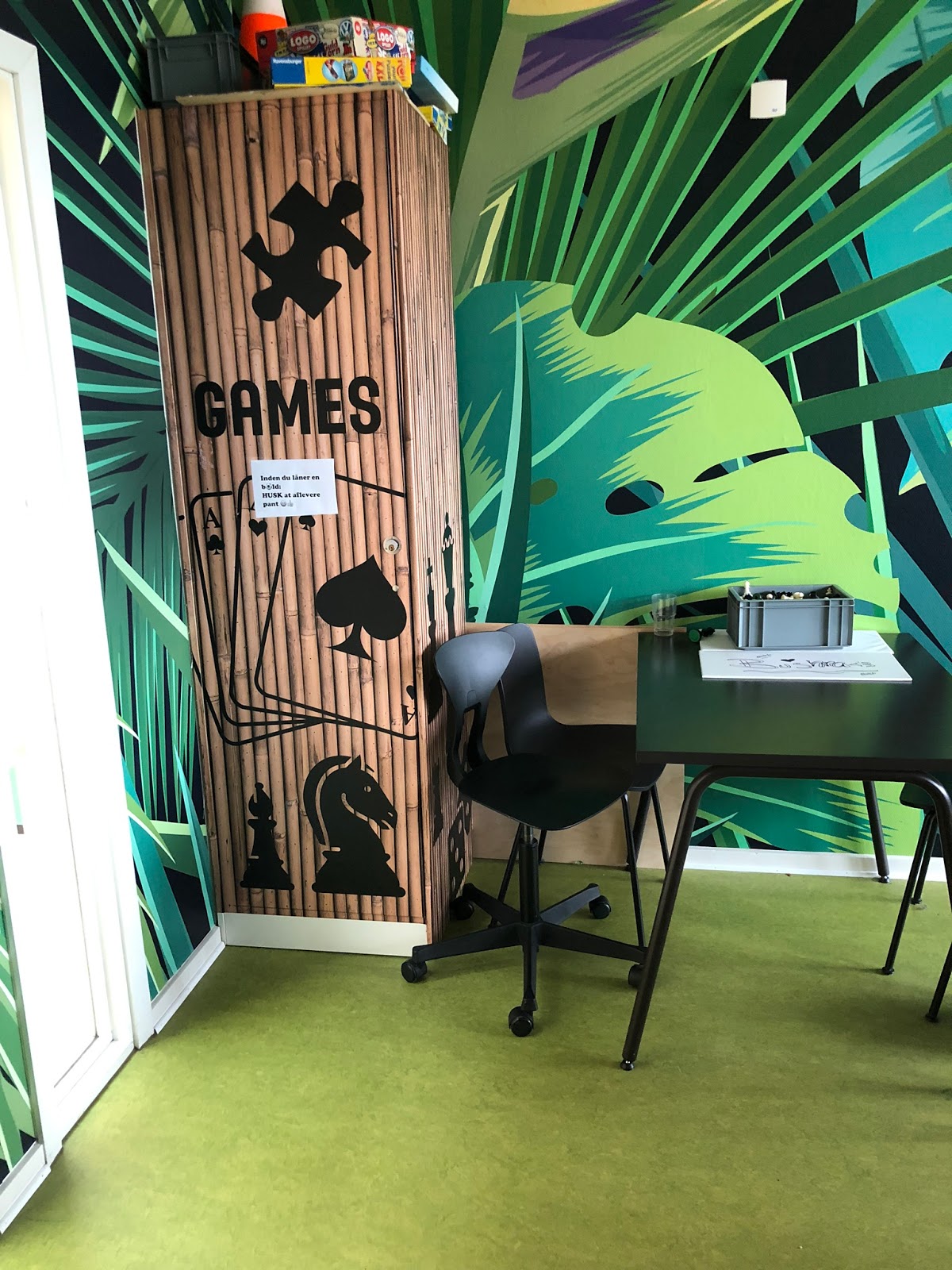
The students' need for quiet, personal time is also honored and respected in this re-design.  A room that they refer to as the jungle room is a place where students may choose to go at any time they need a break or feel overwhelmed.  There are games available for them to play, they can read, bring work to do, or they can rest and reflect.


This changed mindset and the changes in environment led to positive results in the school.  Student scores on the compulsory 9th grade exams increased, moving their average score from low average to high average, there was much more collaboration within the staff, the culture was more positive, and the referrals of students to outside schools for special needs dropped dramatically, from a high of 53 in August 2009 to 31 in August 2016.  In 2016, the leadership team decided they could still improve in their learning mindset and culture.  They decided to engage in a Challenging Learning Process for the following reasons:

  • To secure continuous progression for the students at their school- with a focus on knowledge, attitude, and skills.
  • A wish to develop a shared mindset for learning, a shared language and approach for learning- a shared culture.
  • To move the leaders closer to the daily practice of learning and teaching.  More shared leadership.
As a result of a thorough evaluation, which included interviews with staff, students, and parents and learning walks, Challenging Learning worked with the leadership team to identify the following three Aims:
  • To develop independent thinking and learning in students
  • To encourage a culture where there is a shared language for learning
  • To build a sustainable model of professional learning for teachers and leaders
For the next three years, Søndervangskolen worked with Challenging Learning to achieve these aims.  They developed "champions", who support the professional learning of teachers through a coaching model.  For their leaders, they focused on developing a culture where they are able to build capacity for teachers' professional learning while monitoring the progress of the work. They also worked on structures to actively engage parents, with the goal of having parents who are active and collaborative in the learning process. The Challenging Learning team conducted sessions throughout the three years to train and support the champions, model lessons, conduct parent meetings, and support the leaders in conducting learning walks.  Between these sessions, though, the staff worked hard to continue the improvement work, using these key questions to guide their efforts:  Where are we going?  Where are we now?  What's next?  

At the end of their 3 year journey, they have noticed a complete shift in the language of learning used by the staff and the students.   Feedback in the classroom is focused on progress and learning and includes quality peer feedback.  The students engage in more dialogue and are more willing to take risks.  They have embraced the advantages of challenge and use the language of the Learning Pit to talk about how to demonstrate through their attitudes, skills and knowledge that they are learning and progressing.  One impact we witnessed was the independence of the students.  There were multiple learning spaces that we entered where there was no direct supervision by an adult and yet students were actively working and collaborating. 

They have seen a continued drop in the number of students who are being sent to outside schools for special needs, reaching an all time low of 26 students in November, 2018.  

The leaders in the buildings have moved from a distance management role to an active, instructional leader role.  Through learning walks, they are able to see evidence of students engaged in peer collaboration, students able to articulate what they do when they "struggle", clear, shared learning intentions and students discussing learning.  They are then able to follow up with teachers and champions to celebrate the successes and talk about next steps.  

Søndervangskolen has much to be proud of.  They have done outstanding work and continue to strive for improvement as they focus on learning.  Well done!!


Sunday, September 8, 2019

My journey over the sea to develop some mindset C’s


 In the last week, I was incredibly fortunate to join Professor Carol Dweckand James Nottinghamon their Mindset tour across Europe.  This was a professional highlight for me because they have both been quite influential in shaping my thinking about learning and learners throughout my career.  I started reading about Professor Dweck’s research in the mid-1990’s when I noticed that my gifted students were not taking advantage of the challenges that I was offering because they had a fear of failure.  I was determined to push them out of their comfort zone, knowing that their first real challenge would be crushing to them if it came too late in their educational career.  Their parents, however, wanted some reassurance that this was a good thing for their child. Apparently, the word of a 24-year-old brand new teacher was not sufficient!  It was Dweck’s research on helplessness and mindset that helped me to convince them. In 2011, when I first saw The Learning Pit and began reading the work of James Nottingham, it was like an “aha” experience for me.  The ideas I had about challenging students and the importance of authentic engagement began to take on a more coherent structure and expanded as I read all of the Challenging Learning books, including the Challenging Mindsetbook James wrote with Bosse Larsson, who I was blessed to spend time with on the tour!

I have followed Professor Dweck’s and James Nottingham’s work so closely, that I was not surprised by the fact that I did not hear a lot of brand-new ideas, facts, or concepts during their presentations.  I did, however, gain new perspectives and I heard things in new ways, which caused me to reflect differently on what I was hearing.  I came away with a lot of new thinking but have focused on two main takeaways that I wanted to briefly summarize here- one is how mindset relates to control and the other is what it takes to cultivate a culture for mindset.  

The idea of control has an interesting dynamic in schools.  We want children to have self-control in school, yet we allow them to control very little once they enter school. They are told when to arrive, what to do when they arrive, where they will sit, how they will sit, when they can talk, how they can answer, and who they will work with.  Adults decide what they will learn, how they will learn it, how they will show that they have learned it, when they can show that they have mastered a concept, when they will move to a new topic, etc… It is not surprising that students may find it hard to comprehend that something like intellectual growth, is within their control.  You see, they have been trained to believe that what happens in school is not within their locus of control.  Most children, however, do crave the opportunity to gain control in any area of their life where they can.

Many of the change efforts that are taking place in education are, in one way or another, increasing the level of control that students have throughout their learning journey. Capitalizing on opportunities for students to take control of the factors that put them into a fixed mindset can go a long way in changing the narrative they may have in their head about not having control.  One of the fixed mindset triggers that Professor Dweck mentioned was setbacks and criticism.  This is not surprising if you consider the phenomenon of celebrating winning and shaming losing that James talked about during one of his sessions. Therefore, an example of an opportunity to capitalize on students taking control would be to be intentional about modeling and practicing the idea of turning losses and mistakes into explicit learning opportunities.  Pull a small group of students who struggled to solve a math problem on an assessment- discuss the errors that they made, then ask question like- What did you learn from the errors that you made?  What do you now know you need to work on?  What might you do the next time you encounter a problem like this?  Can you see any other ways to solve it?  Would you like to try another one now or do you want to practice first?  Then celebrate with them and emphasize the fact that the extra time they took to understand their error actually helped them to develop a better understanding of the mathematical concept.  Encourage them to consistently take control of their learning in this way in order to increase their learning potential.

There were two quotes that rang true to me as I think about cultivating culture, one from Carol Dweck- “Mindsets take root only in fertile soil” and one from James Nottingham- “ You are stuck with the system, but you don’t have to be stuck with the thinking that created that system.”  As an advocate for change, I have had this never-ending mantra of “we won’t see change if we keep things the same.”  Just as a real change in learning will not occur by simply changing some instructional practices while maintaining a school setting and structure that mimics that of 60 years ago, a real change in mindset will not occur by simply teaching new language while maintaining practices and behaviors that do not model growth mindset.  

Professor Dweck shared promising research about the positive impact on the growth mindset of college freshman who engaged in a short 50-minute training on mindset development.  Children are malleable and can learn new ideas and skills- we know this to be true.  On the other hand, she also says that an adult’s attitude towards failure is more visible to children than their mindset and is more likely to impact the students’ mindset.  If we don’t talk the talk AND walk the walk, the effect of what we teach the students about mindset is likely to be trumped by what they observe in our behavior because it tells them what we really value and believe.  Cultivating a mindset culture is much more complicated than a training, posters on the wall, using different words, or eliminating stickers.  It is a deep transformation that includes a collective commitment to new values and a new way of thinking that influences the actions, practices and policies within the school. 

Think about your own school or classroom.  Would students feel comfortable talking publicly about their mistakes/failures and what they have learned from them, or is this something they are more comfortable doing in private?  Are student and family challenges talked about as excuses or opportunities?  When students do make mistakes, can they truly take advantage of an opportunity to show that they have grown (without penalty)? Do students seek challenges because they know they will help them to grow?  Do they know how to use a challenge to grow their learning? Highweek Primary Schoolin England reflected on their school and decided they needed a change. Through a Challenging Learning Process, they completely transformed their school in three years through the development of a shared vision.  Jennie Carter and Judy Martyn from Highweek spoke at the opening conference on the tour and did an amazing job telling the story of how this transformation has benefited their entire school community. Here is short clip highlighting their exciting journey.  


THIS is an example of cultivating a culture for mindset!